
Culinary highlights in Munich
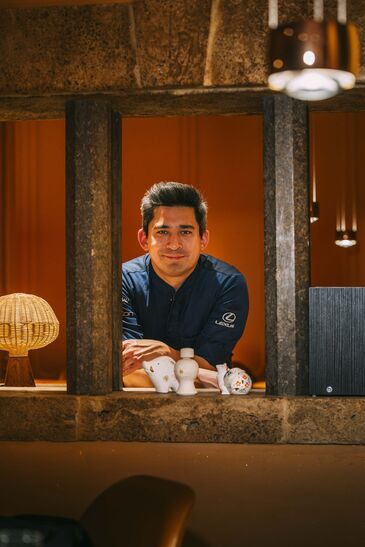
Munich’s Michelin-starred restaurants and the face of modern cuisine
Tohru Nakamura is the face of modern Munich’s restaurant scene. A native of Munich with German-Japanese roots, he is a real crowd favourite. This local hero embodies creative cosmopolitanism with a Munich soul. His cuisine at the Schreiberei, which spans the spectrum from Japan to France, certainly holds its own against international rivals such as Paris or Tokyo.
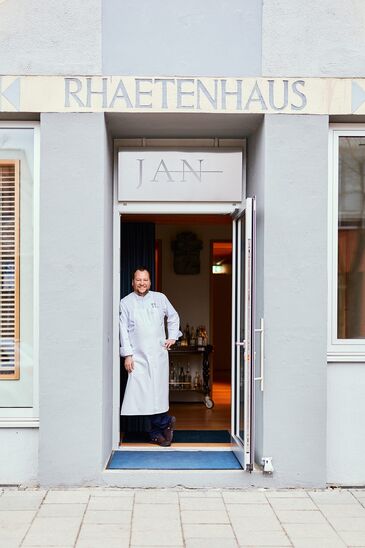
Culinary delights
Jan Hartwig, who has a reputation as a perfectionist, is arguably Munich’s most celebrated Michelin-starred chef at the moment. Having held three Michelin stars at the Atelier im Bayerischen Hof, he has enjoyed a meteoric rise with his own restaurant, JAN, in the Museumsquartier. In 2023, he was awarded three Michelin stars straight off the bat – and he has retained them to this day. And to this day, he continues to set off one culinary firework after another with dishes such as ‘Hackbraten’, ‘Senf-Ei’ and ‘Handkäs mit Musik’.
And to this day, Jan Hartwig continues to set off one culinary firework after another with dishes such as ‘Hackbraten’, ‘Senf-Ei’ and ‘Handkäs mit Musik’.
Munich’s two-star restaurants also serve world-class cuisine with highly individual styles. At the Atelier im Bayerischen Hof, which provided Jan Hartwig with a grand stage for many years, Kevin Romes has been at the helm since April 2026. Romes, born in 1991, is one of the most promising chefs of his generation. Prior to this, he had been chef de cuisine at Skin’s – The Restaurant in Lenzburg, Switzerland, since 2022. Shortly after opening, the restaurant was awarded two Michelin stars. Romes’ time as sous-chef at the IKIGAI restaurant in Schloss Elmau also left a lasting impression on him.
Just a few minutes’ walk from Marienplatz, Christoph Kunz is at the helm of the kitchen at KOMU. Whether it’s the four-course lunch menu or the eight-course dinner menu, the cuisine there is wonderfully flavourful yet clearly thought-through. Using just three main ingredients, Christoph Kunz creates true revelations of flavour.
At Tantris, Munich’s gastronomic icon with its striking 1970s design that has achieved cult status, Benjamin Chmura and his team enjoy experimenting with tangy flavour elements. Take, for example, the grilled pigeon breast served with a red berry sauce. In the evenings, Tantris offers a seven-course menu, which can also be served as a vegetarian option, whilst at lunchtime there is a five-course menu. Alongside the original, the Tantris DNA – awarded a Michelin star – is also a standout. Benjamin Chmura is also in charge of the kitchen here. As well as new creations, the restaurant serves classics spanning five decades of Tantris’ history.
A culinary delight with stars
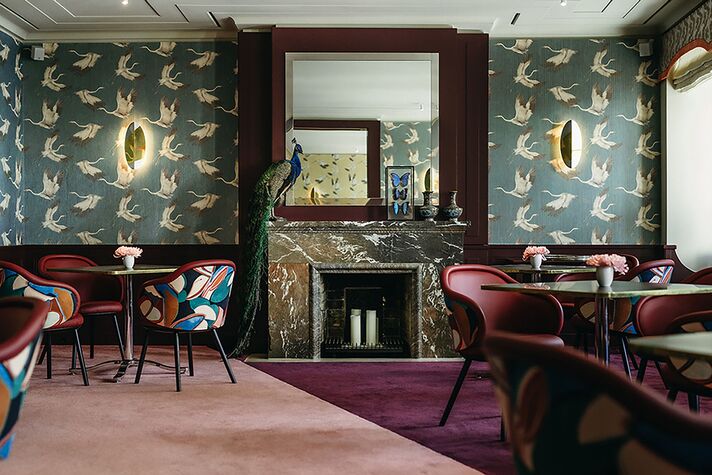
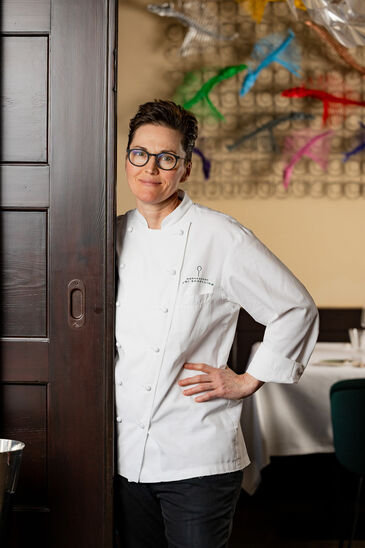
Among Munich’s two-star chefs, Rosina Ostler stands out as the only woman. At Alois – Dallmayr Fine Dining, she combines her Bavarian roots with classic French and Nordic influences. If a 17-course meal is too much to take in, do make a note of Fridays and Saturdays. On these days, alongside the full menu, an 8-course business lunch is available at lunchtime.
You’ll also find plenty of creative ideas in the one-star restaurants of Munich, the gourmet capital. At Les Deux, just a stone’s throw from the Frauenkirche, Nathalie Leblond and her team conjure up light menus with finesse and intensity. At the Showroom, not far from the Deutsches Museum, Dominik Käppeler serves a new menu every two weeks, featuring six to eight courses and exciting contrasts such as ‘prawns, chanterelles, fennel, plums’. The Sparkling Bistro in the Amalienpassage is far more than just a bistro. Jürgen Wolfsgruber, who has an unmistakable fondness for produce from his Austrian homeland, offers a five-course ‘Gustostückerl’ menu in the evening and a four-course market menu at lunchtime.
At Les Deux, just a few steps from the Frauenkirche, Nathalie Leblond and her team conjure up light menus with finesse and intensity.
On Kurfürstenstraße, Brothers is synonymous with exquisite dining. Head chef Daniel Bodamer, whose previous roles include a stint at Tantris, embodies culinary perfection. Sigi Schelling, who also cut her teeth at Tantris, remains true to her culinary style at the Werneckhof: her cuisine is straightforward and free of frills. At lunchtime, there’s a three- or four-course business lunch, whilst in the evening a five-course menu is served. Right in the heart of Giesing, Florian Berger is making a big splash at the ‘Gabelspiel’ with top-class ingredients and excellent service, whilst Sabrina Berger oversees the front of house. The vegetarian menu is available upon advance booking.
Between tradition and innovation
The ‘farm-to-table’ principle is consistently applied at 1804 Hirschau. Whatever the restaurant cannot grow itself is sourced by head chef Lukas Adebahr – who once cooked under Tohru Nakamura at the Werneckhof – from regional producers, for example, for his lake trout fillet with buttery beetroot purée, to which he adds texture and green notes with roasted pistachios and chives.
When it comes to culinary matters, too, it’s worth looking beyond the city limits. At the Mountain Hub Gourmet at Munich Airport – the restaurant is part of the Hilton Munich Airport – Alpine cuisine with a regional flair is served. For Head Chef Marcel Tauschek, this means: char instead of turbot, rabbit instead of Kobe beef. In Starnberg, the gourmet restaurant Aubergine at the Hotel Vier Jahreszeiten has been a fixture for many years. The cuisine: international and seasonal. Since 2014, Aubergine has held a Michelin star under head chef Maximilian Moser. And at the Mind in Markt Indersdorf, Sabrina Fenzel has been focusing on fine dining since 2023 and earned her first star there in 2025. Many ingredients make their way straight from Sabrina Fenzel’s own garden onto the plates of the restaurant’s guests.
Munich stands for tradition and innovation. This also applies to haute cuisine. The combination of creative, top-class cuisine, regional produce and international influences creates experiences that go far beyond simply a ‘good meal’. With passion, precision and hospitality, Munich’s gastronomic scene is undoubtedly one of the most exciting in Germany.

Where Munich’s Michelin-starred cuisine is at home
If you plot the addresses mentioned in this article on a city map, you’ll spot a pattern. Munich’s top-class restaurants are not spread evenly across the city; they follow the established residential areas.
One hub is in Schwabing: Tantris, Werneckhof and Brothers on Kurfürstenstraße are just a few minutes’ walk from one another. A second cluster stretches through the Old Town and Lehel, where you’ll find JAN in the Museumsquartier, KOMU on Marienplatz, Les Deux by the Frauenkirche and the Showroom near the Deutsches Museum. Then there’s Maxvorstadt, home to the Sparkling Bistro in the Amalienpassage.
This is more than just an observation for foodies. Such a concentration arises where there are enough residents who frequent them regularly, and where restaurateurs are prepared to pay high rents for the right location. Both are hallmarks of stable neighbourhoods and thus arguments that apply just as much to exclusive residential addresses in Munich as they do to the restaurants themselves.
The exceptions are noteworthy. The Gabelspiel in Giesing shows that top-class cuisine has long since ceased to be confined to established neighbourhoods, but is now opening up areas that were long considered unremarkable. Experience shows that the regeneration of a neighbourhood follows such signals; it rarely precedes them. And with the Aubergine at the Hotel Vier Jahreszeiten, the gourmet scene extends beyond the city limits to Starnberg, where proximity to the lake and the short journey to Munich have been a combination for decades.

Discuss your concern with us directly and easily by phone. You can reach us Mon - Fri: 9:00 - 18:00 o'clock, Sat: 10:00 - 14:00 o'clock.
Leave us your number and we will call you back promptly.
Make a personal appointment with us for a detailed conversation on site.
More from RIEDEL Magazine
- Discover RIEDEL Magazine – more articles on architecture, design, indulgence and lifestyle
- RIEDEL Insights – market reports, insights and inspiration