
From a workout to a feel-good routine
The home gym is becoming a hybrid
Anyone planning or modernising a villa today no longer thinks in terms of traditional room layouts. Instead, zones are being created that help slow down the pace of everyday life whilst meeting the highest standards of design. A home gym is no longer just a basement room with dumbbells, but an architecturally designed space that blends harmoniously into the overall look of the house. Fine materials, subdued lighting, generous mirrors and perfectly integrated technology create an atmosphere more reminiscent of a boutique studio than a private fitness room. And this is precisely where a trend is emerging that is transforming the entire industry: fitness is no longer seen as a chore, but as a welcome part of an individual’s lifestyle.
The major trends of today – functional training, mobility, low-impact workouts, short, intensive sessions – fit perfectly into this new type of space. They do not require a full array of equipment, but rather intelligent solutions. At the same time, there is a growing desire for regeneration: breathing techniques, cold therapy, infrared heat and recovery tools are now an integral part of the experience. The home gym is becoming a hybrid of a gym, a spa and a retreat.
Stylish and comfortable: work out at home with ease

So why train at home when there are gyms? The answer is surprisingly simple: freedom. A home gym isn’t bound by a timetable, a set sequence of exercises or background noise. It’s a space that adapts to your own rhythm – not the other way round. In a villa, this means you can design the space architecturally in a way no gym ever could: with a view of the garden, featuring natural stone, wood, art, an integrated sound system and equipment that blends harmoniously into the interior. For many, the gym remains a place of variety and social interaction. But the home gym is the place where you truly feel at home.
For many, the gym remains a place of variety and social interaction. But the home gym is the place where you truly feel at home.
The choice of equipment plays a central role in this. Brands such as Technogym have redefined the luxury segment: the Kinesis Personal looks like a sculpture made of metal and leather, a work of art that just happens to enable over 200 exercises. Pent Fitness transforms dumbbells, racks and benches into design pieces made of wood, stainless steel and leather – crafted like furniture, intended as part of a curated interior. NOHRD brings nature back into the room: the SlimBeam and the WaterRower look like handcrafted objects that one would expect to find in a studio rather than a training room. And with its NorsK series, Hammer brings Scandinavian minimalism to the home gym – clean lines, light woods, a calm, almost Nordic serenity.
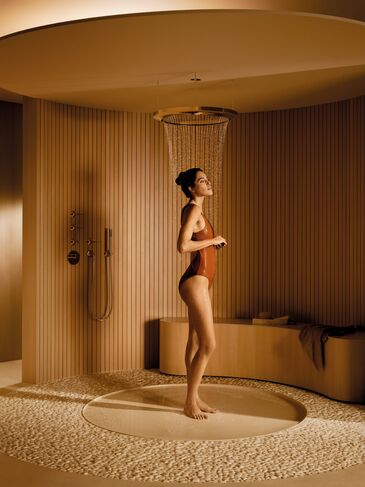
Perfect relaxation in a stunning setting
Wellness facilities are now available in a wide variety of forms, even in rural areas – whether at the nearby thermal spa, the refurbished municipal swimming pool or the exclusive gym in the neighbouring village. But ‘wellness’ is much like a workout itself. The true luxury lies in being completely free to decide when, with whom and how often to enjoy a sauna infusion, a relaxing steam bath or a dip in the ice pool, without having to get in the car and set off with a bag full of things.
Nowadays, a home spa is far more than just a sauna in the basement. It is a private retreat that sets the same architectural standards as a high-quality bathroom or a modern living space. For years, KLAFS has been demonstrating how bespoke saunas, steam baths and infrared lounges can be integrated into villas – often featuring glass fronts, natural stone, warm woods and lighting schemes that bathe the space in a calm, almost meditative atmosphere. The ensemble is complemented by sensory showers, relaxation areas, daybeds and – where the layout permits – direct access to the garden or pool.
Technology is by no means a foreign element here any more. Apps such as Peloton, Technogym Coach, Alo Moves and Apple Fitness+ provide personalised training programmes that adapt in real time. AI-powered analyses optimise movement patterns, wearables monitor exertion and recovery, and smart lighting and sound systems create atmospheres tailored to your mood and the time of day. This makes the home gym not only more attractive, but also smarter.
Design pieces with a cardio effect
Current trends clearly show the way forward: fitness equipment is becoming design pieces that are not hidden away but deliberately displayed. Wellness areas are architecturally staged, often using natural materials and large glass surfaces. And the desire for individuality is growing: bespoke saunas, personalised training zones, and integrated sound and lighting systems that adapt to the mood and time of day. Luxury no longer means excess, but precision – spaces that are perfectly tailored to the needs of their occupants. And they symbolise a lifestyle in which exercise and regeneration contribute to a happier, more balanced and more energetic life.
The latest trends clearly show the direction we’re heading in: fitness equipment is becoming design objects that are not hidden away, but deliberately displayed.
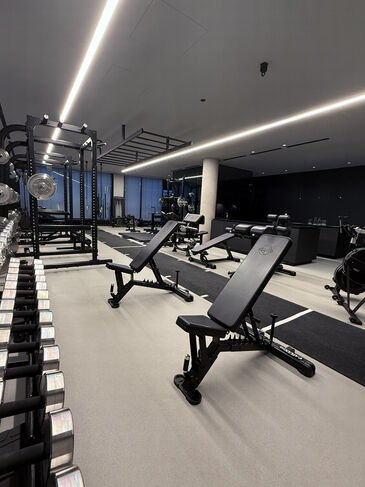
Where performance takes centre stage
Anyone walking past the striking building on Munich’s Arnulfstraße would hardly guess what lies behind the dark glass façade. FIFTYNINE deliberately appears inconspicuous – a place you don’t stumble upon by chance, but one you seek out deliberately. Inside, a space opens up that is more reminiscent of a laboratory than a gym: clean lines, subdued lighting, absolute concentration. This isn’t about training, but about developing performance. Brothers Andreas and Bastian Riegger built FIFTYNINE from a shared vision.
Having grown up on Lake Constance, shaped by sport and nature, the two followed different paths before joining forces professionally. Andreas studied sports science in Munich and began working with demanding clients at an early stage. Bastian comes from a background in architecture, but realises that he is not interested in buildings themselves, but rather in their effect on people. Together, they learn from international mentors and develop a system that goes far beyond traditional training.
Their approach is called Performance Management: a structured process that combines diagnostics, strength training, recovery, nutrition and mental clarity. What matters is not the volume of data specifically collected and analysed during the processes, but its translation into decisions that extend a person’s peak performance years. Special spaces with a distinctive aesthetic also play a central role in the overall concept. The brothers design private gyms and corporate fitness facilities – ranging from city villas to international projects. In this way, architecture becomes a performance booster.
FIFTYNINE does not work with hourly packages, but with retainer agreements. A maximum of one hundred clients are supported at any one time – entrepreneurs, partners and investors. Growth is not driven by marketing, but by trust. Andreas sums up the FIFTYNINE philosophy: “We’re not for everyone. But for those we are made for, we want to be the top choice in Munich. And in the long term, the only one that really comes into consideration.”
What a home gym means for the floor plan
Anyone who incorporates a fitness area and spa into their home is changing the floor plan, not just the furnishings. Both areas require sufficient ceiling height, ventilation, protection against damp and easy access to the outdoors – doing this retrospectively is expensive, but it costs almost nothing to factor it in at the planning stage.
When it comes to a house’s value, it is not so much the facilities themselves that count, but rather how naturally they fit into the design. A spa in the basement without natural light remains just a cellar room, whereas a gym with access to the garden becomes a selling point. Anyone looking for a house of this calibre is most likely to find it where the property was designed from the outset rather than converted: in architect-designed houses in Munich and amongst the existing stock of villas and luxury properties. This issue of *Die Kultur des Echten* explores just how much of this depends on the interior design.

Discuss your concern with us directly and easily by phone. You can reach us Mon - Fri: 9:00 - 18:00 o'clock, Sat: 10:00 - 14:00 o'clock.
Leave us your number and we will call you back promptly.
Make a personal appointment with us for a detailed conversation on site.
Related topics
- Buying a villa in Munich – detached houses with space for your own ideas
- Architect-designed houses in Munich – designed from scratch rather than converted
- The culture of authenticity – interior design as a philosophy
- Discover RIEDEL Magazine – further articles on architecture, design, indulgence and lifestyle